Prove
A signed receipt for every dataset and model. Anyone can re-run the check themselves; they do not have to take your word, or ours.
AI safety first. The TC Verified mark on an AI product shows which badged models are behind it, and every answer carries a receipt the company signed. Underneath is a chain of custody: a signed record of what each model was made from, that a customer, an auditor or a court can check themselves. When a source is withdrawn, you see everything built from it in seconds.
Accounts are by invitation while we onboard our first teams. Checking a record is free and needs no account.
Built and tested this week. The tests behind it
Audits replay a deployment’s answers on the badged weights. A swapped model was caught at the second question.
How audits workAgent permissions, receipts committed once, predictions before results and licence lanes, as Move contracts on testnet.
What runs on SuiPoint the lookup at a model folder. Only tensor hashes leave your machine, and it finds who badged it, with what terms.
Look a model upThey come from customers in a sales call, from lawyers in a dispute, and from regulators in an audit. Most teams answer from memory and spreadsheets. The people asking want evidence.
What did this model learn from?
Were we allowed to use it?
If a source is withdrawn, what does that touch?
Every dataset, model and agent message gets a signed entry, linked to what it was made from. That single record is what makes the rest possible.
A signed receipt for every dataset and model. Anyone can re-run the check themselves; they do not have to take your word, or ours.
Permission is checked before training starts. If a source is not cleared for that use, training is refused, and you are told why.
From any model back to every input it learned from. From any input forward to everything built on it.
Pull a source and everything downstream is flagged at once. Nothing is deleted, so the history stays checkable.
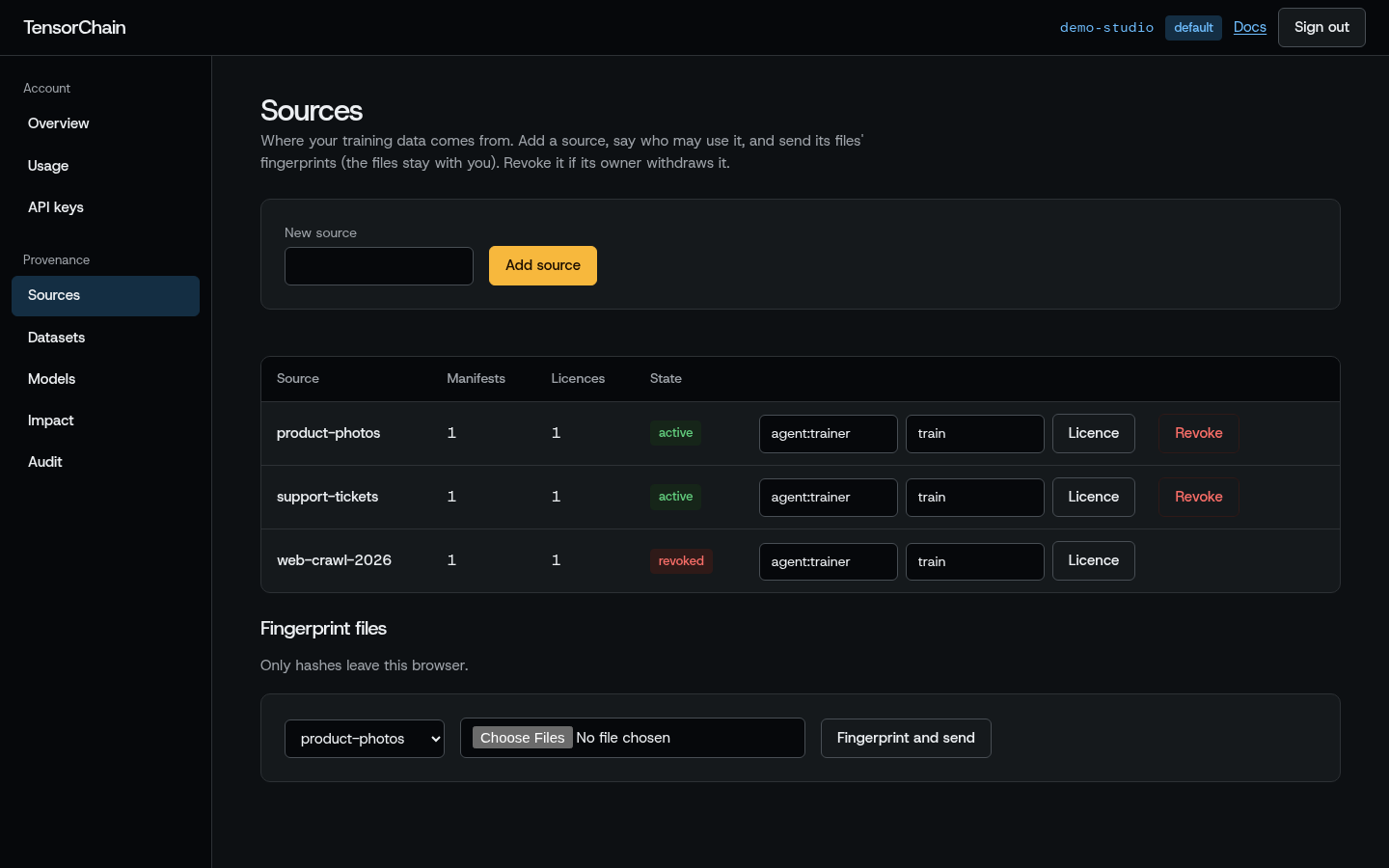
This is the app your team uses. Each source shows who may use it and whether it is still good. Withdraw one, and the models trained on it change state in front of you.
When anyone checks a record, TensorChain re-runs the proof from the stored evidence. It never just reads a stored “OK”.
| Answer | What it means |
|---|---|
| valid | The signature holds and the evidence matches. Nothing it depends on was withdrawn. |
| revoked | The proof still holds, but something it was built on was withdrawn. |
| invalid | Something was changed or forged. This answer always wins over the other two. |
You train where you train today. TensorChain sees file names, sizes and fingerprints, never the files. Setup is two lines around your training code.
import tensorchain.cloud as tc
p = tc.Client("https://tensorchain.io", key)
p.ingest_folder("photos", "/data/photos")

with p.training("agent:trainer", "train", ["photos"]) as run:
    train()                      # on your own GPUs
    run.model("out/weights.safetensors")
If a source is not licensed for training
Training is refused before your code runs.
You get the reason as a code your pipeline can act on.
We run TensorChain on our own data pipeline. These figures are from a recorded test on 24 November 2026.
6,661
batches of data recorded, and every one re-verified, in 15.3 seconds.
3.5 s
to find all 761 batches of one withdrawn source, and nothing from any other.
The mark on your AI product, with a signed receipt for every answer.
Read moreShow what a model learned from, and that you were allowed to use it.
Read moreHand your customer one file proving what your agents did.
Read morePut your face and voice on the record, with your terms and a proof page.
Read moreA receipt for every render, traced to its scene and its assets.
Read moreAttested builds. Find every release that ships a bad dependency.
Read more