The Python SDK
Two lines around your training loop. It fingerprints your data where it sits and runs the gate before your code.
QuickstartTensorChain writes down each step between raw data and a finished model as a signed entry, linked to the step before it. This page explains what those entries are and what you can do with them.
Six kinds of entry cover the path from data to model. Each one is signed, and each names what it was built on.
| Entry | What it is |
|---|---|
| Source | Something you take data from: a folder, a bucket, a code repository, a crawl. Its owner registers it. |
| Licence | The owner’s signed permission: this party may use this source, for these uses, until this date. |
| Manifest | One batch of fingerprints from a source, linked to the batch before it, so the order cannot be rewritten. |
| Dataset | A set of sources at a moment in time, for one user and one use. It can only be created through the gate. |
| Model | Trained weights, identified by fingerprint, with the dataset it was trained on as its parent. |
| Revocation | A signed decision to withdraw something, with a reason. Only its owner can make it, and it deletes nothing. |
Every entry carries the evidence it was made from. Checking it means re-running the proof from that evidence: the fingerprints are recomputed, the signature is verified, and everything it was built on is checked the same way.
| Answer | What it means |
|---|---|
| valid | The signature holds, the evidence matches, and nothing above it was withdrawn. |
| revoked | The proof still holds, but a source, a licence or a parent was withdrawn. |
| invalid | A changed byte, a forged signature or a stolen key. Invalid always outranks revoked. |
A dataset, and so a training run, is created only if every source passes. The check runs before your training code does. If it fails, your code never starts and you get the exact reason.
Every decision is recorded, allowed or refused, so you can show later that the check really ran.
| Refused because | Code your pipeline receives |
|---|---|
| The source was never registered | source_unregistered |
| Nobody licensed it to you | licence_required |
| Licensed, but not for this use | use_not_licensed |
| The licence ran out | licence_expired |
| The licence was withdrawn | licence_revoked |
| The source itself was withdrawn | asset_revoked |
| Its newest data was never recorded | batch_unattested |
Because every entry names its parents, you can walk the chain in either direction. Start from a model and reach every file it learned from. Start from a source and reach every dataset and model built on it.
When a source’s owner withdraws it, you revoke it once. Everything downstream is flagged, the next training run on it is refused, and you get the list of what to retrain or pull.
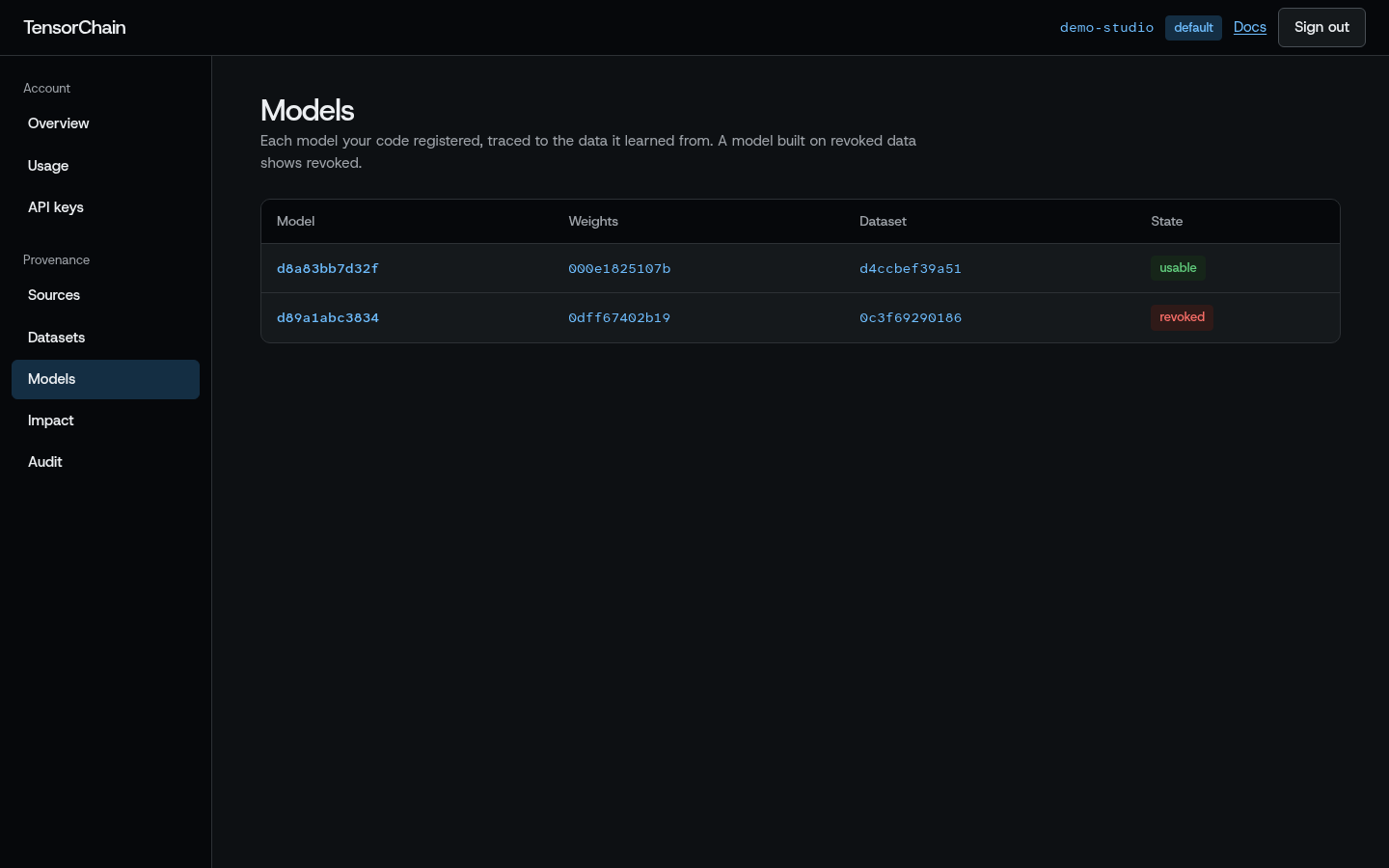
All three write to the same record, so a team can mix them.
Two lines around your training loop. It fingerprints your data where it sits and runs the gate before your code.
QuickstartThe same operations over HTTPS, for pipelines in any language. Keys carry scopes and expire.
The hosted APISources, datasets, models, impact and audit in a browser, plus your usage and your API keys.
The web appConnectors read a source and produce its fingerprints. The data itself is not copied to us.
Your data, GPUs and weights stay on your machines. TensorChain holds the record: names, fingerprints, licences and signatures.