Pull one source. See every model it touched.
For teams training AI models. TensorChain records what each model learned from, checks you were allowed to use it before training begins, and tells you exactly what to retrain when a source is withdrawn.
The problem it solves.
Training data arrives from many places: licensed sets, customer uploads, crawls, purchased archives. Months later someone asks where a model’s data came from, or an owner withdraws consent. Without a record made at the time, the honest answer is “we are not sure”.
TensorChain makes that record as you work, so the answer is a lookup.
A customer asks
“Was our data used to train the model you sell to others?”
A rights holder asks
“Remove my work, and tell me which models learned from it.”
An auditor asks
“Show me that the licence was checked before this training run.”
How a team uses it, start to finish.
Name your sources
Register each place data comes from, with its owner: a folder, a bucket, a repository, a crawl.
Record the permission
The owner signs a licence: who may use the source, for what, and until when.
Send fingerprints
The SDK hashes the files where they sit and sends names, sizes and hashes. The files stay with you.
Build a dataset
Choose the sources for a training run. The gate checks every licence for that use. A source that fails stops the run.
Train as you do today
On your own GPUs, inside two lines of the SDK. When training ends, the weights are registered against the dataset.
Show the proof
Export one audit report, or share a public link where anyone can check a record without an account.
Withdraw when you must
Revoke a source. Every dataset and model built on it is flagged, and the next run on it is refused.
Everything in one place.
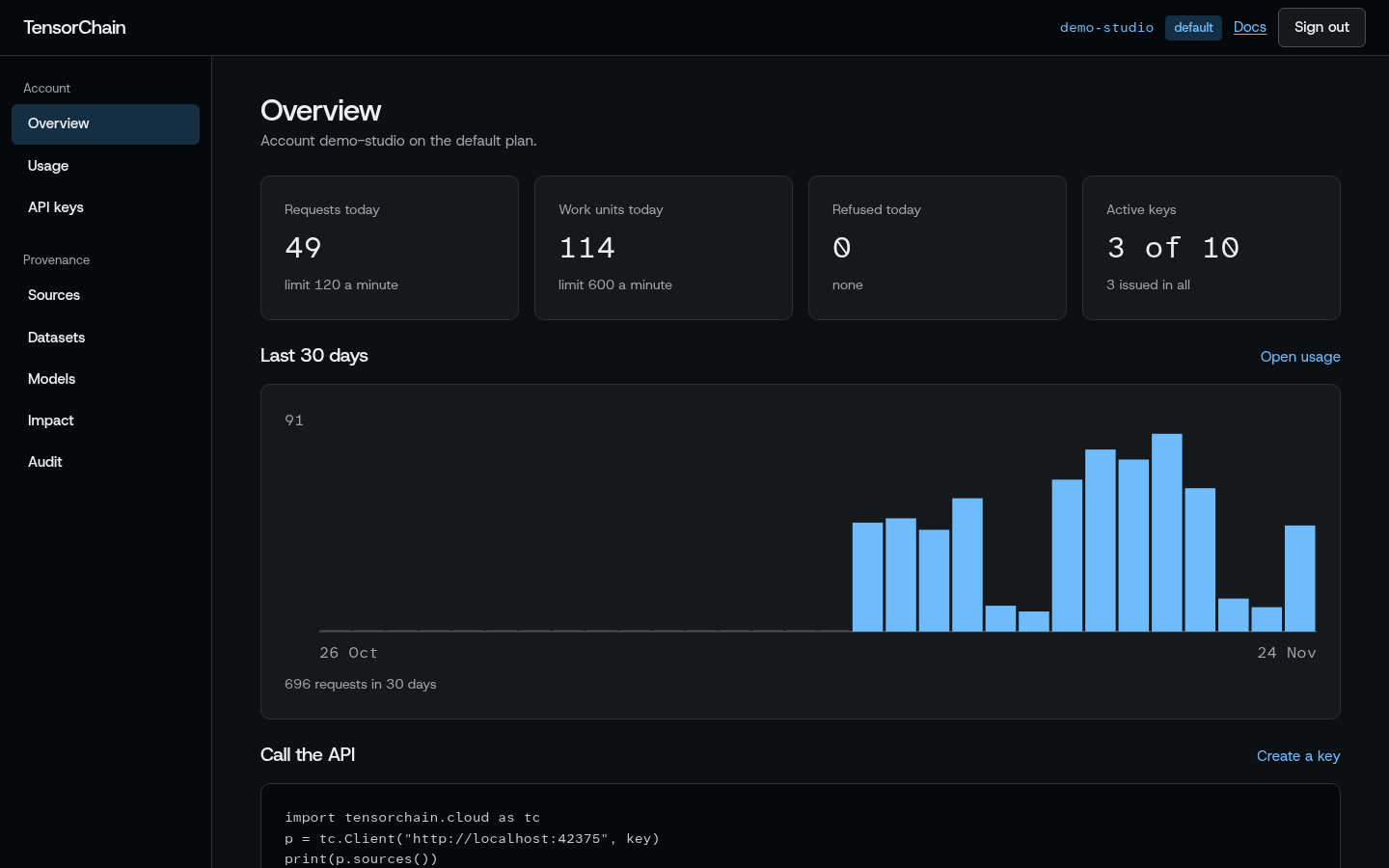
The overview shows what your account has used. Each data source lists who is licensed to use it. Models show the dataset they came from, and turn red the moment the data under them is withdrawn.
What happened when we tested it.
Two recorded tests from 24 November 2026: one against the live service at tensorchain.io, one in our full test suite with a real browser and the SDK writing to the same account.
- Live: we withdrew a source
- The model trained on it went from valid to revoked, with no one editing it.
- Live: a new dataset on that source
- Was refused, with the code asset_revoked.
- Test suite: the impact of one withdrawal
- Came back as exactly that source’s 2 batches, 1 dataset and 1 model.
- Test suite: the audit report
- Showed the source as withdrawn, and the other source untouched.
TC Badges: a certificate for your model.
Badge your model and every tensor is fingerprinted, with your terms and what it was built from. Anyone who downloads it checks their copy in one command. Revoke the badge and every online check says so.
It catches tampering.
In our own tests a sleeper agent trained into a model was caught and named exactly, layers 22 to 27, by comparing it with the clean model’s badge. A trigger hidden in the chat template was caught the same way.
Find a badge from the file.
Point the lookup at a model folder. It fingerprints the files on your machine and sends only tensor hashes, never file bytes. It finds published badges with byte-identical tensors, including a copy with one tensor changed, by its other tensors.
Your weights stay with you.
Fingerprints are computed on your machine. Only they are signed and published.
From licensed data to a model that checks itself.
Recorded tests from 24 and 25 November 2026, on our own machines.
- A model that checks itself
- A .tcx file carries the model, its runtime and its badge. It checks itself before it runs: an intact copy answered, a copy with one changed byte refused to start, and so did a copy whose badge was revoked.
- Surgery on the weights
- On a model with a sleeper trained in, the bad layers were replaced from the clean model. The trigger’s secret went from appearing in 80% of triggered answers to 0%, and all 310 tensors now match the clean model byte for byte.
- The closed loop
- A biomedical expert was trained on one of our GPUs on 1,999,872 tokens from the 15.9-million-token biomedical set, every document checked for its licence. Its held-out biomedical loss fell 10.3%, about 4 points of it specific to biomedicine: the other fields improved too. It was badged and shipped as a self-checking file. Our demo store shows recorded answers from that file, each with its receipt.
What it helps you answer.
TensorChain gives you evidence, made at the time, for every question about where a model came from. You train on your own GPUs; it checks the licence before any step and records what came out.
It shows what a model was made from.
By fingerprint, with the licence that covered each source at the time.
It shows the check ran first.
Every gate decision is recorded, including the refusals.
It names what to retrain.
When a source is withdrawn, every model that learned from it is listed.